

Over the last decade, I have observed a changing pattern in how corporates approach innovation.
There was a period when many organisations moved quickly into visible innovation activity. They launched innovation labs, organised hackathons, hosted technology showcases, sponsored accelerator programmes, partnered with ecosystem platforms and visited innovation hubs around the world.
These activities created energy. They helped corporates connect with startups, research institutions, technology companies, design studios, solution providers and ecosystem partners. They also helped organisations signal that they were serious about innovation.
However, in more recent years, there has been a noticeable shift.
Some corporates have pulled back from activity-led innovation. Others have become more selective, asking harder questions about business value, adoption, productivity, cost efficiency, customer impact, revenue opportunities and measurable outcomes.
This shift is important.
Innovation should not be measured only by the number of events organised, ideas collected, pilots launched or partners engaged. These activities may create momentum, but they do not automatically create value.
The more meaningful question is whether innovation helps the organisation become more competitive, productive and cost-efficient, while creating new revenue opportunities, improving customer outcomes, strengthening sustainability and becoming more future-ready.
Why Co-Innovation Is Harder Than It Looks
On the surface, collaboration between corporates and external innovation partners should be a natural match.
Corporates have problems, customers, assets, industry depth, operating environments and scale. Innovation Solution Providers, or ISPs, bring speed, specialised capabilities, emerging technologies, fresh perspectives and the willingness to challenge conventional ways of working.
ISPs may include startups, scale-ups, research institutions, AI solution providers, robotics firms, platform companies, design studios, process innovation specialists, workflow automation providers, specialist vendors, data partners, system integrators and ecosystem intermediaries.
Yet, in reality, corporate and ISP collaboration is often harder than expected.
Many corporates are interested in innovation, but there is a wide spectrum of readiness. Some are still learning how to engage external innovators. Some can run pilots but struggle to scale. A smaller group has built the governance, funding, business ownership and operating model needed to convert innovation into measurable outcomes.
Similarly, ISPs want corporate customers, but not all are ready for enterprise requirements, governance expectations, cybersecurity reviews, procurement processes, integration complexity and operational scale.
This is where the IDEAS 2.0 Co-Innovation Maturity Model becomes useful.
This is where the IDEAS 2.0 Co-Innovation Maturity Model becomes useful.
What Is IDEAS 2.0?
The IDEAS 2.0 Co-Innovation Maturity Model is a practical framework to help corporates and ISPs understand where they are in their co-innovation journey.
The model consists of five stages:
Initial, Discovery, Engagement, Acceleration, Scale and Sustain
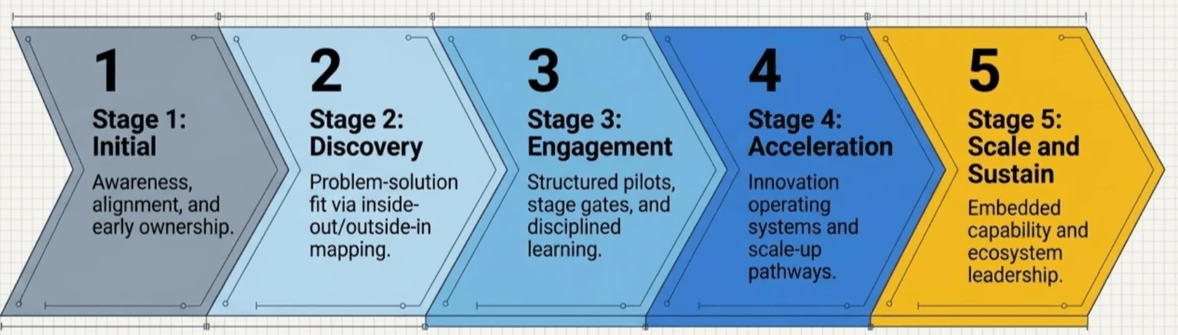
Each stage reflects a different level of readiness, behaviour and capability. The purpose is not to label an organisation permanently. It is to help leaders and teams ask a more honest question:
Where are we really today?
Stage 1: Initial
At the Initial stage, the organisation recognises that innovation is important, but innovation remains largely an aspiration.
Leaders may talk about transformation, digitalisation, disruption or AI adoption, but the organisation has not yet translated these themes into a structured innovation agenda.
Innovation may still be associated with brainstorming sessions, technology showcases or one-off events. Business units may not have clearly defined problem statements. There may be no dedicated experimentation budget. Procurement, legal, technology, risk and compliance processes may not be ready for iterative collaboration.
The biggest risk at this stage is treating innovation as inspiration without action.
The focus should be awareness and alignment. Leaders need to clarify why innovation matters, what problems the organisation wants to solve and who will own the journey.
Stage 2: Discovery
At the Discovery stage, the organisation begins to explore the external innovation ecosystem more actively.
It conducts internal discovery of problem statements, maps emerging capabilities, identifies relevant ISPs and engages ecosystem partners.
Good discovery requires both outside-in and inside-out thinking.
Outside-in helps the organisation understand market signals, emerging technologies and ISP capabilities. Inside-out helps the organisation understand its own pain points, constraints, assets, processes, data, users and decision rights.
Co-innovation only becomes meaningful when these two sides meet.
This is also the stage where the mandate of the innovation team becomes important. Without a clear mandate, innovation teams may be expected to engage ISPs and coordinate stakeholders, but lack the authority, access or decision rights to move initiatives forward.
The key outcome of Discovery is stronger problem-solution fit.
Stage 3: Engagement
At the Engagement stage, the organisation begins to work directly with ISPs through innovation challenges, proofs of concept, sandbox trials, pilot projects, design sprints, co-development workshops or controlled experiments.
This is where many corporates become excited, but it is also where many collaborations start to fail.
The failure is usually not because the solution is poor. More often, the engagement was not properly designed. The business problem was unclear. The success criteria were not agreed upfront. The business owner was not committed. The data was not available. Procurement or security reviews started too late. The pilot had no operational pathway after completion.
A proof of concept should not be treated as an innovation trophy. It should be treated as a disciplined learning process.
Before a pilot starts, the team should know what it is testing, what decision will be made after the test, and how commercial, data and intellectual property considerations will be handled.
A successful pilot should have a pathway to operationalisation, scale-up, procurement, partnership or investment. An unsuccessful pilot should still generate learning. A pilot that produces no decision is the real failure.
Stage 4: Acceleration
At the Acceleration stage, the organisation has moved beyond isolated experiments.
The question changes from “Can we run pilots with ISPs?” to “Can we convert the right pilots into measurable impact?”
This requires an innovation operating system. It includes problem prioritisation, business ownership, governance, funding, procurement pathways, risk review, pilot design, success measurement, post-pilot decisions, operationalisation budgets and handover to operations.
Business units must stop seeing innovation as something done by a central team. They must become co-owners. The innovation team can facilitate, connect and govern the process, but the business must own the problem, adoption and value realisation.
This stage also requires portfolio thinking. Not every innovation project should be judged the same way. Some initiatives deliver near-term productivity or cost efficiency. Some build medium-term capability. Others explore longer-term strategic options.
A mature organisation knows how to manage different innovation time horizons with suitable expectations and measures.
Stage 5: Scale and Sustain
At the Scale and Sustain stage, co-innovation becomes part of the operating model.
It is no longer a side activity or special project. It becomes embedded into strategy, transformation, business planning, capability development and ecosystem partnership.
At this level, the organisation can repeatedly sense market changes, identify strategic problems, engage external innovators, test solutions, scale what works and retire what does not.
Innovation culture becomes critical. A sustainable innovation culture does not mean everyone must become an entrepreneur or technologist. It means people across the organisation understand how to identify problems, test ideas, work with external partners, manage uncertainty and adopt better ways of working.
At this stage, there is no exit criteria. The goal is sustainment.
The organisation continuously senses, tests, scales, retires and renews, while contributing to the wider ecosystem.
From Activity to Impact
One of the biggest lessons in corporate and ISP co-innovation is that activity does not equal maturity.
A corporate may organise many innovation events but still be at the Initial or Discovery stage. Another corporate may run fewer pilots but have better problem definition, stronger business ownership and clearer scale-up decisions. That organisation may in fact be more mature.
For corporates, the question is not whether they are working with startups or ISPs.
The more important question is whether these collaborations are helping the organisation become more competitive, productive, customer-centric, sustainable and future-ready.
That is why the IDEAS 2.0 Co-Innovation Maturity Model is useful. It helps organisations look beyond innovation activity and ask:
Are we merely interested in innovation?
Are we discovering the ecosystem?
Are we engaging ISPs through pilots?
Are we accelerating adoption?
Or have we built a sustainable model for long-term co-innovation and growth?
For a more practical guide, download the full IDEAS 2.0 Co-Innovation Maturity Playbook, which includes:
The maturity matrix
- Stage-by-stage indicators
- Diagnostic questions
- Key tasks and expected outcomes
- Stage criteria and sustain criteria
- Practical templates for problem discovery, ISP assessment, pilot design, post-pilot decisions and scale-up readiness
Download the full playbook to assess where your organisation is today and identify what to strengthen next.
Final Thought
Co-innovation is not a shortcut to transformation. It is a capability that must be built over time.
Innovation is not an event. Co-innovation is not a pilot. Ecosystem building is not just networking.
The real goal is to move from ideas to adoption, from pilots to scale and from collaboration to value creation.
That is the essence of the IDEAS 2.0 Co-Innovation Maturity Model.
Related Articles
Discussions & Comments
For discussion and comments on this topic, please visit my linkedin article page, click here.